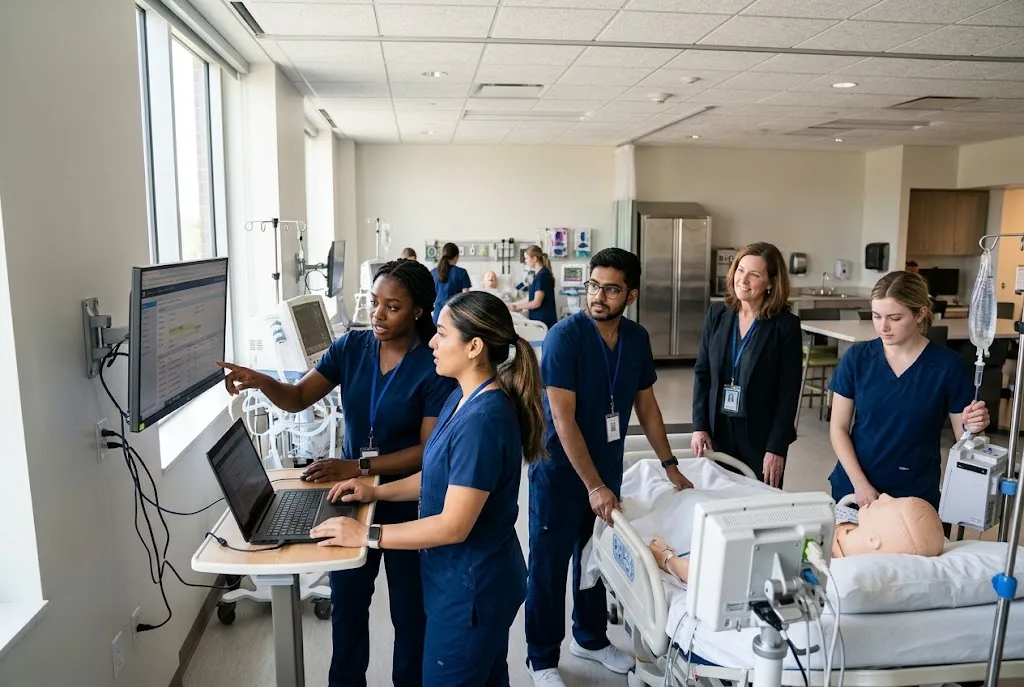
Healthcare simulation gives students an opportunity to practice clinical situations in a controlled educational environment. Instead of learning only through lectures or reading, students can work through realistic scenarios and apply what they have learned.
As healthcare becomes increasingly digital, simulation can also include electronic documentation and simulated patient records. This gives students an opportunity to develop both clinical and digital skills before they enter real healthcare environments.
For nursing programs and other healthcare education providers, combining simulation with digital learning tools can create a more complete educational experience.
What Is Healthcare Simulation?
Healthcare simulation uses realistic scenarios, activities, or technologies to help students practice healthcare-related skills.
Depending on the program, simulation may involve:
- Patient assessment
- Clinical decision-making
- Communication
- Teamwork
- Documentation
- Patient-care scenarios
- Digital healthcare workflows
Simulation does not necessarily need to reproduce a hospital environment exactly. Its purpose is to create a safe learning situation where students can apply concepts, make decisions, receive feedback, and improve.
Why Simulation Matters in Healthcare Education
Healthcare students eventually have to apply classroom knowledge in real-world situations.
Simulation provides an intermediate step between theoretical learning and actual patient care.
Students can practice responding to scenarios without putting real patients at risk. Instructors can also observe how students approach a situation and identify areas that need additional teaching.
This makes simulation useful for developing confidence as well as practical knowledge.
1. Connect Theory With Practice
Students may understand a concept when reading about it but find it more difficult to apply that knowledge in a realistic situation.
Simulation can bridge this gap.
For example, an instructor can introduce a patient scenario and ask students to review the available information, assess the situation, and determine an appropriate response.
The activity transforms theoretical information into a practical exercise.
2. Create Realistic Patient Scenarios
The quality of a simulation depends heavily on the scenario.
Useful scenarios should reflect the educational level of the students and connect directly to the course objectives.
A simulated patient record might contain:
- Patient history
- Vital signs
- Allergies
- Medication information
- Clinical notes
- Assessment findings
Students can then use this information as part of the simulation.
Realistic details can make the activity more engaging while helping students understand how different pieces of information relate to one another.
3. Include Electronic Documentation
Modern healthcare depends heavily on electronic records.
Students may therefore benefit from practicing documentation as part of simulation rather than treating it as a completely separate subject.
An educational EHR can provide a simulated environment where learners review patient information and practice documentation.
This can help students understand how clinical activities and electronic records are connected.
4. Support Different Learning Levels
Beginning students and advanced students do not necessarily need the same simulation experience.
Introductory learners may work with simple patient scenarios, while advanced students can handle more complex cases involving multiple pieces of information.
Educators should therefore look for tools that can support different levels of difficulty.
This allows simulation activities to develop as students progress through their programs.
5. Encourage Clinical Reasoning
Simulation can be useful for developing clinical reasoning because students have to interpret information and make decisions.
Instead of simply memorizing facts, students may need to determine:
- What information is important?
- What should be assessed?
- What action should be considered?
- What should be documented?
- What additional information may be needed?
This process encourages learners to think through situations rather than simply recall information.
6. Improve Communication and Teamwork
Healthcare is collaborative.
Many simulations involve multiple students working together to respond to a scenario.
Students can practice communicating observations, discussing decisions, and coordinating activities.
These experiences can complement classroom discussions about professional communication and teamwork.
7. Give Students a Safe Environment to Make Mistakes
One of the major advantages of simulation is that students can learn from mistakes in a controlled environment.
A student may overlook information, make an incorrect decision, or fail to document something appropriately.
Instead of affecting a real patient, the mistake becomes a learning opportunity.
Instructors can use the situation to explain what happened and how the student could approach a similar scenario differently.
8. Provide Meaningful Instructor Feedback
Simulation becomes more valuable when students receive feedback after completing an activity.
Instructors can discuss:
- What the student did well
- Where information was missed
- How decisions could be improved
- Whether documentation was appropriate
- What should be practiced again
Feedback allows students to turn an experience into a learning opportunity.
9. Extend Learning Beyond the Simulation Lab
Digital simulation tools can sometimes allow students to continue practicing outside scheduled lab sessions.
This can give learners additional opportunities to review scenarios, practice documentation, or revisit concepts.
For students who need more repetition, this can be particularly useful.
However, educators should determine how digital activities fit within the overall course structure.
10. Evaluate the Technology Before Adoption
Educational institutions should not choose simulation technology based solely on appearance.
Before adopting a platform, educators should consider:
- Curriculum compatibility
- Scenario quality
- Student usability
- Instructor controls
- Documentation capabilities
- Accessibility
- Scalability
- Technical support
- Pricing
The technology should solve an educational need rather than simply add another software product to the curriculum.
The Role of an Educational EHR
An educational EHR can add another dimension to simulation.
Students can review simulated patient records before a scenario, use the information during an activity, and document relevant details afterward.
This creates a workflow that connects clinical reasoning with digital documentation.
For example:
Review patient information → Participate in simulation → Document findings → Review the record → Receive feedback
This can help students understand why accurate documentation is an important part of healthcare practice.
ChartFlow and Healthcare Education
Programs exploring digital tools for healthcare simulation can consider education-focused EHR platforms.
ChartFlow provides an educational EHR environment designed around healthcare learning and simulated scenarios. Students can use simulated records to become more familiar with electronic documentation and digital healthcare workflows.
This can complement classroom teaching, nursing simulation, and other healthcare education activities.
ChartFlow also offers student-focused resources through its course catalog, providing additional learning opportunities for healthcare students.
How Educators Can Build Better Simulation Activities
A successful simulation does not necessarily require the most complicated technology.
Educators can start with a clear learning objective.
For example:
Objective: Students should practice reviewing patient information and documenting relevant findings.
Then build a scenario around that objective.
Students can receive a simulated patient record, participate in the scenario, complete documentation, and discuss their decisions with the instructor.
This keeps the technology focused on learning rather than allowing the software to become the main objective.
Questions to Ask When Choosing a Simulation Tool
Before selecting a platform, educators should ask:
- Does it support our learning objectives?
- Can students work with realistic scenarios?
- Does it provide simulated patient information?
- Can students practice documentation?
- Can instructors create or customize activities?
- Can faculty review student work?
- Does it support different levels of learners?
- Can students access activities outside the lab?
- Is the platform easy to use?
- Can it scale across multiple courses?
These questions can help institutions compare tools based on educational value rather than marketing claims.
Common Challenges
Technology can also introduce challenges.
Students may become distracted by complicated interfaces, while instructors may struggle if creating activities requires extensive technical knowledge.
Another potential problem is using simulation without a clear learning objective.
The best approach is to start with the educational goal and then choose technology that supports it.
Educators should also ensure that students understand the difference between simulated learning and real clinical practice.
Final Thoughts
Healthcare simulation can give students a valuable bridge between classroom learning and real-world healthcare environments.
When digital tools and educational EHR systems are incorporated appropriately, students can practice not only clinical decision-making but also documentation and digital workflows.
The most effective simulation programs focus on clear learning objectives, realistic scenarios, instructor feedback, and student usability.
Rather than choosing technology simply because it has numerous features, healthcare education providers should select tools that genuinely improve the learning experience and prepare students for the increasingly digital nature of modern healthcare.